WhyBusinessesNeedIntegratedTechSystemsin2026(Not Just Development)
Summary — Featured Snippet
Most businesses in 2026 do not struggle because of missing tools — they struggle because their systems are disconnected. Integrated tech systems combine websites, APIs, automation, and AI into a single workflow, helping businesses reduce manual work, improve performance, and scale efficiently.
What Is Broken in the Current Market
Most companies today rely on multiple tools that do not communicate with each other. A website that does not feed into the CRM. A payment system that is not reconciled automatically. A customer inquiry form that creates a manual follow-up task. This is the hidden cost killing modern businesses.
Common issues include
- Websites not connected to CRM or analytics
- Manual data entry across tools and platforms
- Poor integration between payment, marketing, and operations
- Slow and unscalable backend systems with no room to grow
Why This Matters
Disconnected systems lead to inefficiency, higher operational costs, poor user experience, and missed revenue opportunities. This is the biggest hidden problem in modern digital businesses.
The Real Cost of Disconnected Systems
When systems are not integrated, the costs compound quietly. Teams spend hours on repetitive tasks that should be automated. Data becomes inconsistent across platforms. Leads and customers are lost because follow-ups are delayed or missed entirely. And when the business tries to scale, it hits infrastructure ceilings that require expensive rebuilds instead of simple extensions.
- Teams spend hours on repetitive tasks that automation should handle
- Data becomes inconsistent across platforms, leading to poor decisions
- Leads and customers are lost due to delayed or missed follow-ups
- Scaling becomes difficult and expensive without integrated architecture
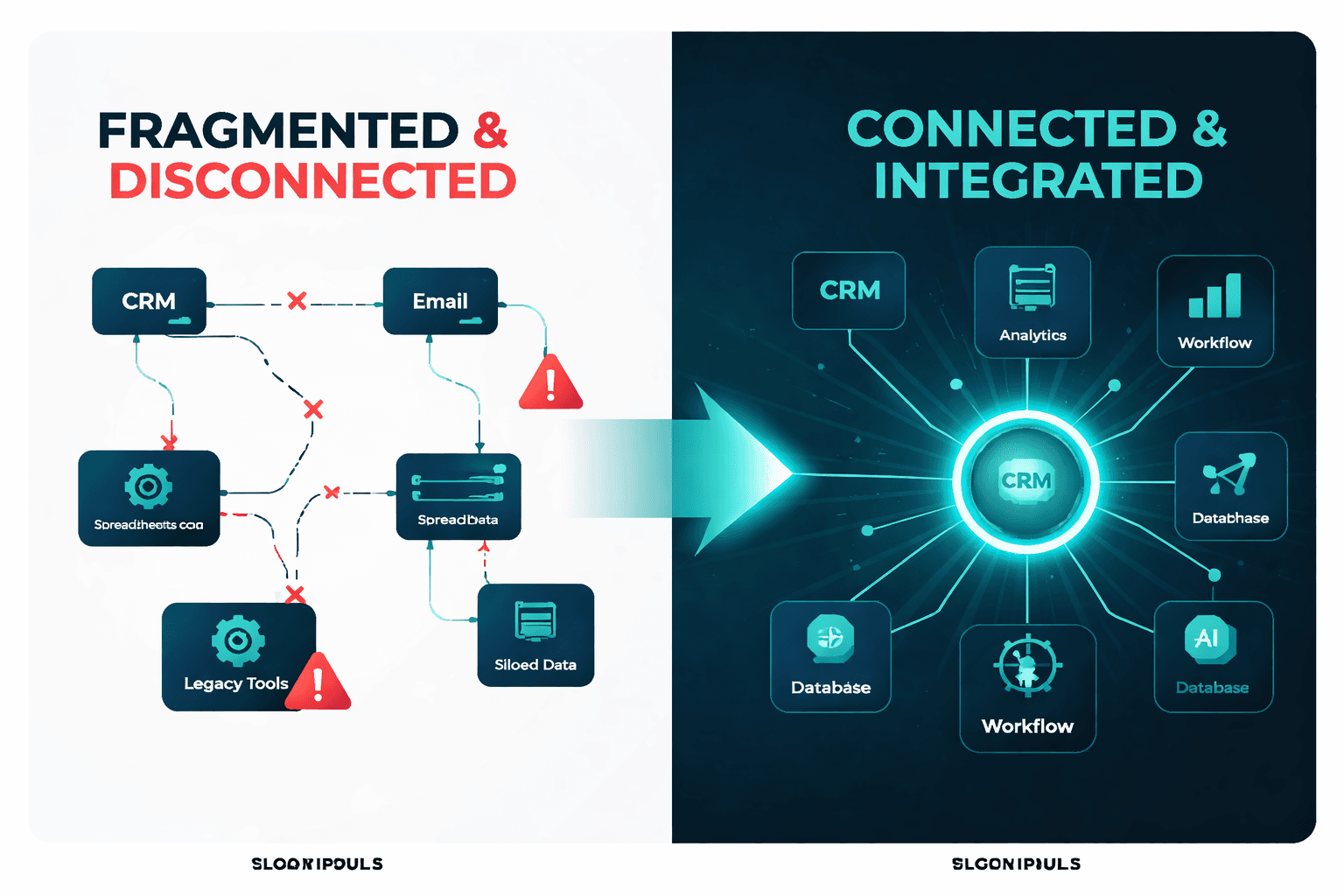
Disconnected tools vs a connected integrated system — the difference in 2026
What Modern Businesses Actually Need
Successful businesses in 2026 focus on system integration instead of tool accumulation. The question is not which tool to add next — it is how to make every tool you already have work together seamlessly.
1. Connected Infrastructure
All systems — CRM, website, APIs, analytics — share data seamlessly. When a lead fills in a form, it automatically appears in the CRM, triggers an email sequence, and logs in the analytics dashboard. No manual steps.
2. Automation-Driven Workflows
Manual processes are replaced with automated actions. Invoices are generated and sent automatically. Appointment confirmations go out without anyone pressing a button. Support tickets are routed to the right team instantly.
3. AI-Powered Operations
AI is used for customer interactions, decision support, and workflow optimization. An AI agent answers customer queries at 2am, qualifies leads before they reach your sales team, and flags anomalies in your data before they become problems.
4. Scalable Architecture
Systems are designed to handle growth without major rebuilds. A business that starts with 100 users and grows to 100,000 should not need to rewrite its entire infrastructure. Good architecture anticipates growth and makes scaling an extension, not a reinvention.
What We Improve at Nikarva
At Nikarva, we build integrated tech systems that connect every layer of your business — from the frontend your customers see to the backend operations your team runs.
System Connectivity
We connect APIs, SaaS tools, and internal platforms so data flows smoothly across every part of your operation.
Performance & Scalability
We optimise speed, infrastructure, and backend performance so your system handles growth without breaking.
Automation & AI
We automate workflows, communication, and internal processes — reducing manual effort and increasing output.
Conversion & Revenue
We align technology with your customer journey and business goals — so better systems translate to better results.
How We Build Integrated Systems
Business Analysis
We understand your workflows, revenue model, and system gaps before writing a single line of code.
System Architecture Design
We define data flow, integrations, and system interactions — so every component knows its role.
Development with Scalable Tech
We use modern frameworks, cloud infrastructure, and an API-first approach that grows with you.
Integration & Automation
We connect tools and automate workflows to eliminate manual work across your operations.
Continuous Optimisation
We improve performance, conversions, and system reliability on an ongoing basis.
Real Business Impact
Operational Efficiency
- Less manual work
- Faster execution
- Fewer errors
Revenue Growth
- Better conversions
- Faster response times
- Improved customer experience
Scalability
- Systems grow with your business
- No need for frequent rebuilds
Better Decisions
- Real-time data insights
- Improved business visibility
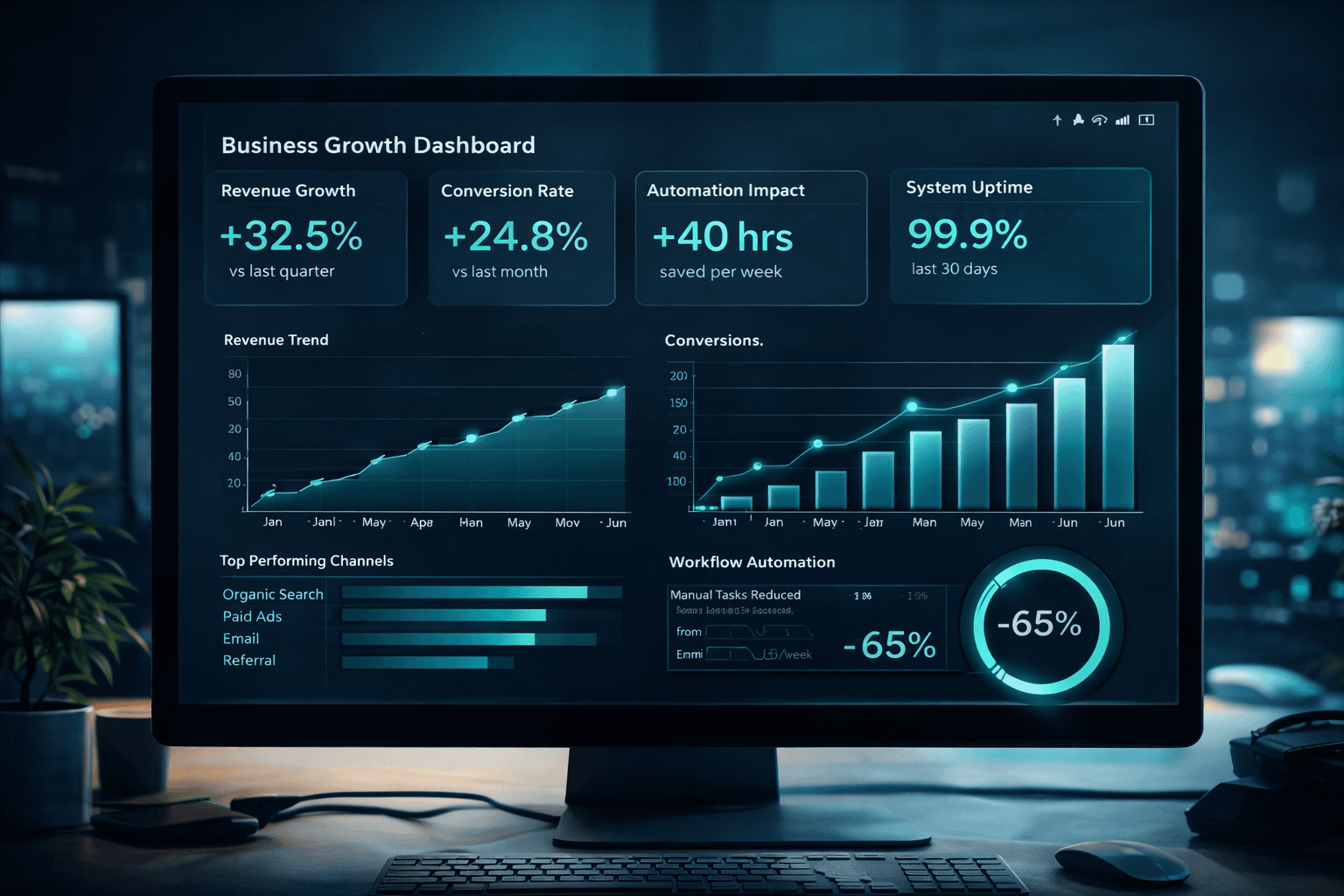
What integrated systems deliver — efficiency, growth, and scalability
Key Takeaway
Businesses that win in 2026 are not using more tools — they are using better-connected systems that automate, scale, and perform efficiently. The question is not what tool to add next. It is how to make everything you already have work as one.
Frequently Asked Questions
What is an integrated tech system?
An integrated tech system is a connected ecosystem where tools like websites, APIs, CRMs, and automation workflows work together to streamline operations and improve efficiency.
Why are disconnected systems a problem?
Disconnected systems create inefficiencies, increase manual work, and lead to data inconsistencies, which negatively impact business performance and revenue.
Do small businesses need system integration?
Yes. Even small businesses benefit from integration because it reduces manual work and creates a scalable foundation for growth without expensive future rebuilds.
What is the difference between development and system design?
Development focuses on building features, while system design focuses on how all components work together efficiently. Both matter — but system design is what determines whether your tools scale.
How does AI fit into integrated systems?
AI enhances integrated systems by automating repetitive tasks, improving decision-making with real-time data, and optimising workflows — from customer interactions to internal operations.
If your business systems feel slow, disconnected, or manual — you do not need more tools. You need integration.
Start building a system that actually works.